

Summer 2026 Toll Updates: Romania’s New TollRo System Is Delayed
Yet another start date for TollRo, plus the 1 July shake-up in the BeNeLux region and what 2027 holds for Lithuania

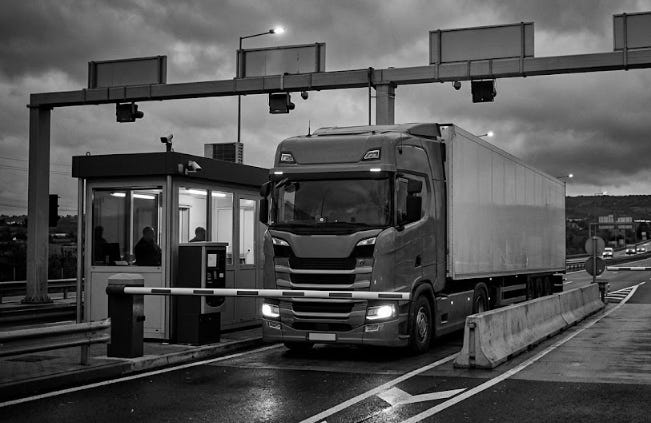
While Romania’s transition to the per-kilometer TollRo system has been delayed until October 2026, European road freight operators face immediate cost increases as the Netherlands and Flanders launch new distance-based tolls or CO2 surcharges on July 1, with Lithuania following in 2027.
On 10 June 2026, the Chamber of Deputies in Romania approved the bill pushing the operational launch of TollRo from 1 July to 1 October 2026. The act still awaits presidential promulgation, but it is expected to happen soon. This decision shifts the same planned system, the same legal backbone (Law 226/2023), and the same tariff order issued last October by three more months on the clock, after an earlier six-month slip from the original 1 January 2026 target.
The delay appears to be driven less by politics than by readiness. Romania’s road authority, CNAIR, received the test version of the national tolling platform only in June, leaving less than a month to check whether it could work reliably before the July deadline. That testing matters: the system has to match each truck with official vehicle data, including weight and emissions class, before it can calculate the correct per-kilometre charge. Launching without proper checks would raise the risk of wrong charges, disputed fines and disruption for hauliers.
The Financial Impact: Calculating the New Rates
For operators, the basic model is still the same. TollRo will apply to freight vehicles over 3.5 tonnes, with charges calculated by distance travelled, vehicle weight category, road type and Euro emissions class. Payment will be possible through an on-board tolling unit, a pre-declared single-trip route ticket, or CNAIR’s free eTarife app. The important correction is the price level. The final rates are not the low figures floated during the early 2025 consultation. The enacted tariff table, set by Order 1925/2025, is roughly three times higher than that of the earlier summer draft.
So a toll for the standard Euro VI 40-tonne truck should cost about €0.10/km on motorways and €0.05/km on national roads. Such a truck running ~100,000 km a year on Romanian tolled roads faces roughly €4,700 (all national roads) to €9,500 (all motorway) and around €7,000 on a realistic mixed profile, close to five times today’s ~€1,425/year vignette charge rather than the doubling the early draft implied. But the same math used for trucks doing only sporadic transits through Romania would now be in the carrier’s favour, dropping the need to purchase an expensive vignette for once-a-month transits. The new per km toll would still allow Romania to sit among the cheapest in the region, considerably below Hungary, Austria, Slovenia and Bulgaria, but the gap has narrowed sharply, and the pain will affect the older domestic fleets where the emission surcharges bite hardest.
Industry Backlash: Margin Pressure on Local Carriers
This is also where most of the industry’s concern is focused. Romanian transport associations, including COTAR and UNTRR, have warned that the new system will be hardest on small local carriers, especially those running only a few trucks and older Euro IV or Euro V vehicles. They argue that higher road charges could speed up consolidation in a market where many operators already work on thin margins. COTAR has also pushed back against any setup where CNAIR’s own app becomes the only free payment channel, calling instead for open access so private fleet-management and toll platforms can connect to the system.
The mood among drivers is even more direct. On transport forums and social media, many compare the planned charges with “German-level fees” while pointing to Romania’s slower road network, single-lane national roads and long border delays. For them, TollRo is often seen less as an environmental reform and more as another cost layered on top of recent increases in vignettes, insurance and compliance systems such as RO-eTransport. Cross-border operators may also face a messy transition: full European toll-service interoperability is expected to come later, possibly only in early 2027, so some carriers may need to rely on route tickets or temporary on-board units at launch.
The 1 July 2026 cluster: Netherlands and Flanders
Romanian toll development is not the only one worth circling. On 1 July 2026, the Netherlands will introduce its long-prepared distance charge (vrachtwagenheffing) for N2 and N3 trucks over 3,500 kg, ending the Eurovignette validity in the country. Every truck - domestic or foreign - needs a working OBU from an approved provider; enforcement starts day one.
The same day, Flanders adds a CO2 surcharge to its existing Viapass kilometer charge - not a new toll, but a new pricing parameter. Trucks are slotted into five CO2 classes, with Flemish rates spanning roughly €0.010 to €0.395/km. The catch: every OBU in Belgium must carry a registered CO2 class before 1 July, even vehicles only running in Brussels or Wallonia, where the surcharge does not yet apply.
On the horizon: Lithuania’s “Via Toll” in 2027
Lithuania is next in line. From 1 January 2027, the country plans to replace its vignette system with “Via Toll”, a distance-based electronic road charge for transport categories N1, N2 and N3, covering freight vehicles from light commercial vans to heavy trucks over 12 tonnes. The network is expected to cover around 2,800 km of tolled roads, with charges based on distance travelled, vehicle category, weight, axle count, emissions class and fuel type.
The first published figures suggest that a standard heavy truck will face a rate in the same broad range as the Netherlands, and above Romania. The standard Euro VI 40-tonne, five-axle truck will face roughly €0.12/km of toll costs, subject to final confirmation by the Lithuanian authorities.
For the market, the message is familiar: these developments confirm the ongoing trend of implementing the EU’s intention to phase out annual vignettes in favour of per km tolls using digital payment models, with cleaner vehicles paying less and high-mileage operations facing costs that are easy to calculate but impossible to ignore.
Oleksandr Kulish
Senior Consultant
Trimble Transportation (Transporeon)