


The United Kingdom and Ireland have many historical and economic differences. But geography dictates many similarities as well, as both nations are island economies, both are heavily road-dependent, and both are absorbing the same cost shocks that have rattled continental markets in 2026. Here is where each market stands at the halfway point of the year.
The UK Road Freight Market: Consolidating Under Pressure
UK diesel prices surged 33% between February and April - from £1.41 to £1.87 per litre - before partially retreating to £1.75 in June, and domestic spot rates tracked this in real time. Contract rates moved more slowly, as most haulage agreements include a diesel floater clause with a one-to-three-month lag, meaning the March shock is just finishing being incorporated into contracted pricing.
The one lane where the increase handily beats expectations beyond the fuel story is UK to Germany, where contract rates rose 17% over H1, the only GB-origin corridor to post double-digit growth. Fuel amplifies on a >1,000 km haul, but the real culprit is demand: rejection rates on this lane rose through spring, signaling that carriers now wield some pricing power on a corridor traditionally deprived of significant demand. Worth watching separately: From GB to France or to the Benelux area, contract rates increased but at lower adjustment levels despite high rejection rates, suggesting a correction there is also possible.
But the headline number for UK road freight is not a rate figure. It is carrier bankruptcies: more than 2,000 haulage companies entered insolvency between 2021 and 2025, nearly double the total of the preceding five-year period. That is roughly eight operators exiting the market every week for four consecutive years. A 2025 sector analysis found that 36.8% of UK transport and storage companies held absolutely no cash reserves, the lowest of any UK industry. A further 39% of operators sat in a high-failure-risk zone, with a combined working capital shortfall across the sector of £706 million. In 2026 these trends are only expected to accelerate.
These are not the businesses with room to absorb shocks of the Strait of Hormuz closure. As UK diesel prices climbed up, we saw a spike in haulage insolvencies. The cashflow mechanics are brutal: fuel bills arrive weekly, customer invoices settle in 30 to 90 days, and the gap in between is where businesses fail.
What is emerging from this attrition is a two-speed market. At the top, consolidation is accelerating. The operators being squeezed out are the smaller and regional players, businesses without the capital to invest in technology, sustainability credentials, or the scale to absorb cost shocks. The grim reality is that even as the fuel prices drop, the sector’s contraction is far from finished.
A Border System Contributing Toward Crisis
A development that deserves close attention in the summer is the EU’s Entry/Exit System. Launched in October 2025 for coaches and freight vehicles, and progressively enforced from April 2026, EES requires biometric registration for non-EU nationals, including British citizens, entering the Schengen area. Because French border controls operate on the UK side of the Channel, those checks happen at Dover and Folkestone before departure.
The May bank holiday offered the first serious stress test. The Port of Dover declared a critical incident as peak wait times hit four and a half hours. France invoked an emergency clause to temporarily suspend the extra biometric registration step, but the underlying problem of insufficient processing throughput for peak volumes was not resolved. In early July, the Port’s Chief Executive warned of another imminent critical incident as summer tourism peaks. Port’s prediction shows holiday traffic heading for France could face queues spilling out of the port and onto the M20 for miles, influencing freight movement as collateral damage. While lorries do not share the same lanes as tourist traffic, they share the same approach infrastructure and surrounding road network. When that network seizes, the knock-on effects for freight scheduling are significant. What makes the outlook particularly uncertain is that the worst may still be ahead: as of early July 2026, most cross-Channel tourist cars at Dover were still being processed manually due to technical issues. Full biometric enrollment for all passenger groups has not yet been activated and could be switched on with little notice, adding a further layer of first-registration delay to an already strained system.
Whether the summer passes without a major freight disruption event, or whether a sustained critical incident forces a rethink of routing and scheduling across the Channel, is genuinely hard to call. What is clear is that carriers were already advised to build significant buffer times into cross-Channel schedules and consider congested departures during peak holiday weeks. For just-in-time supply chains, that advice is worth taking seriously rather than waiting to react.
Ireland: A Smaller Market, A Sharper Crisis
If the UK is navigating a structural reckoning, Ireland is in the middle of one. The fuel crisis hit Irish operators with force, as soaring diesel prices triggered nationwide protests, as slow-moving truck and tractor convoys brought the Dublin traffic to a standstill. The government’s Diesel Rebate Scheme and the new Road Transporters Support Scheme have provided carriers with an emergency liquidity buffer and reduced fuel excise tax until the end of July. Whether that support continues beyond remains an important near-term variable for sector stability.
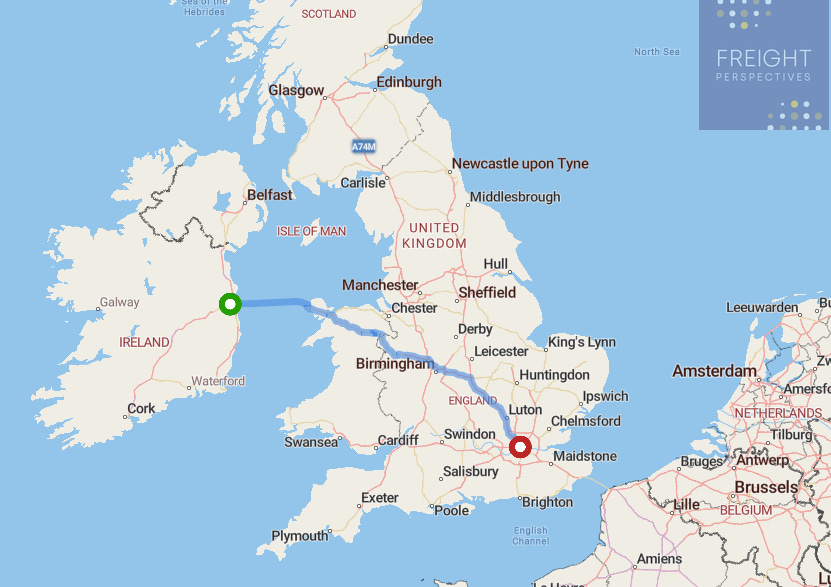
But the most strategically significant development in the Irish market is geographic. The UK Landbridge, which was historically the fastest route from Ireland to continental Europe, has seen lorry traffic fall 30% since Brexit, as direct Ro-Ro services between Ireland and the EU have doubled. In June 2026, a new year-round service emerged, connecting Cork directly to Boulogne-sur-Mer with six weekly sailings, a 22-hour crossing designed around driver rest periods. Dublin Port expects direct-to-continent volume to grow for decades, highlighting a continuous post-Brexit traffic adjustment.
The EES dynamic adds another layer to this shift. Every additional hour of friction at the Short Straits makes the direct maritime bypass more attractive relative to the Landbridge. If the summer of 2026 delivers the kind of disruption the Port of Dover is warning about, it may accelerate the structural rerouting of Irish freight away from the UK corridor faster than any commercial calculation alone would have done.
What to Watch
Both markets are feeling the same forces: fuel volatility, driver shortage, and the ongoing reconfiguration of post-Brexit trade architecture. The UK/EU SPS agreement, targeted for mid-2027 implementation, will ease agrifood flows meaningfully - the UK government estimates a £5.1 billion annual economic benefit - but dynamic alignment with EU rules introduces its own compliance risks, and broader industrial freight friction remains largely unchanged.
The operators who survive this period will be fewer, larger, and more selective. For shippers with exposure to either market, all of this will mean that securing capacity and long-term relationships with logistics partners in Britain and Ireland will become a priority in the long-term.
Oleksandr Kulish
Senior Consultant
Trimble Transportation (Transporeon)